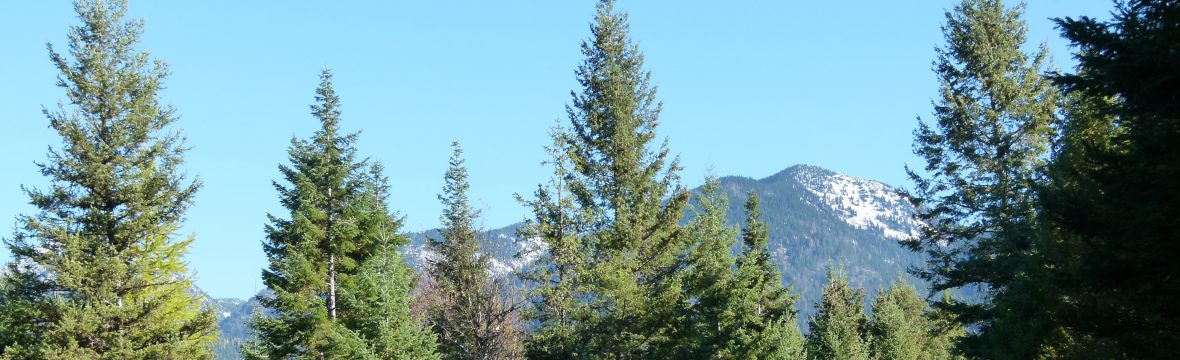


Owning forested property in NW Montana is a dream come true for us. It’s also a privilege, which my hubby Jim and I take very seriously. A healthy forest includes managing the trees, plants and animals that belong on this land. Luckily, three organizations, Montana DNRC, US Forest Service and Montana State University’s Extension Forestry offer a Forest Stewardship Workshop for forest landowners just like us. The 3-day workshop includes everything we needed to complete a management plan for our property. Once the plan is complete, Jack, our resource professional will come out to our property for a site visit to provide customized guidance for our specific needs. In today’s post, I share our forest stewardship goals, information about the workshop and a garden update.
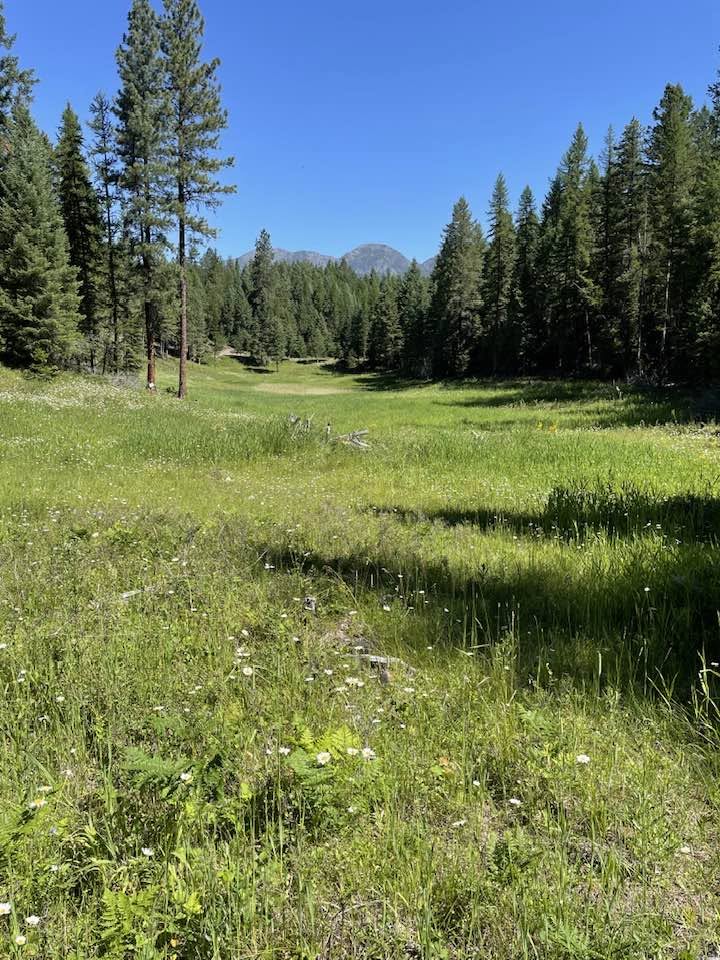
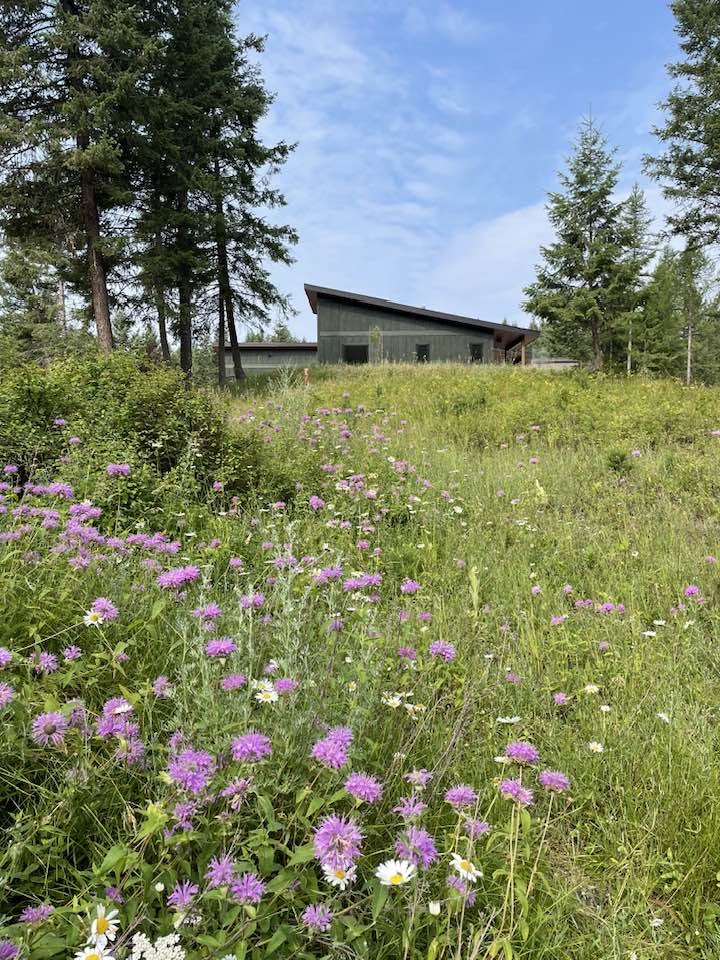
View of our north meadow looking towards Swan Mountains:
If you own forested property in NW Montana, I recommend you take the Forest Stewardship workshop. “The mission of the MSU Extension Forestry is to provide education and outreach to private forest landowners around Montana. It is estimated that more than 50,000 landowners own 4 million acres of forestland in the state.” Montana is the fourth largest state (93 million acres) and forests cover 23 million acres or about one-fourth of Montana. We’ve learned to observe, measure, gather and classify data about our forest. It certainly has helped us assess the trade-offs and consequences of managing and making informed decisions about the property. The workshop guides participants in:
- Forming ownership objectives and forest goals
- Discovering more about forest ecology, fire and insect hazard management, wildlife habitat enhancement, trees, understory plants and range management, and forest health assessment and maintenance
- Completing an ecological inventory of their forestland
- Writing a Forest Stewardship Management Plan
Workshops are taught by a team of natural resource professionals who come from the private sector, forestry, state and federal agencies. “After 34 years, the program has begun seeing second and third generation participants who wish to carry on their family’s forest stewardship legacy.” Since 1991, almost 3,000 owners with over 1.37 million acres have completed the workshop.
Forest Stewardship
Your forest is managed by you and driven by your objectives. By identifying your primary goals and concerns, you will be able to objectively formulate an action plan based on the best available science. You’ll conduct biological surveys of your land, which will help you develop a Forest Stewardship Plan that is nationally accredited and certifiable. This workshop will help you learn about your forest, what species you have, how are they growing, the age of your trees and what animals share your forest.
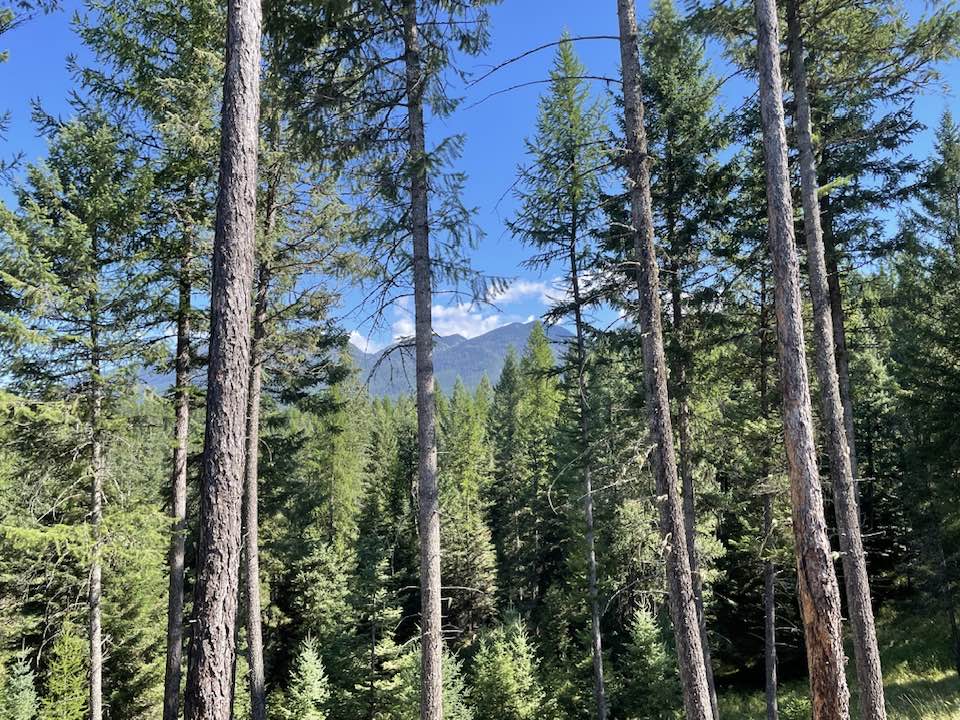
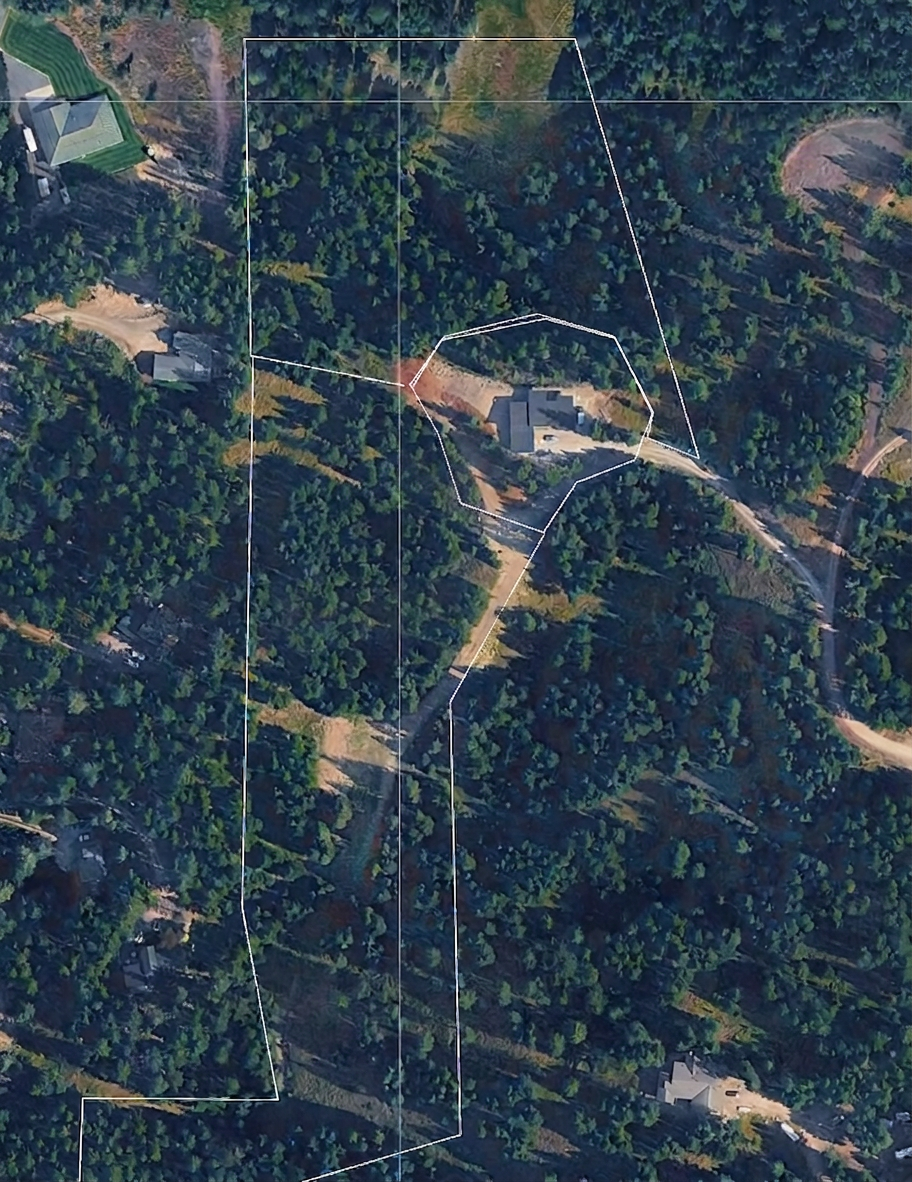
Creating objectives and a forest inventory, which you’ll include in your plan will help you reach your goals. If available, you may qualify for cost share opportunities to complete some of your objectives, such as forest thinning or log harvesting. My hubby, Jim and I had already done a lot of research about fire risk, but we still learned several important tips to protect our home. In addition, the workshop covers everything you’ll need to understand and manage your property. Below is a picture of our property divided into three management units:
FOREST ECOLOGY
Our forest consists of water, soil, plants, animals, trees and much more. In the workshop we learned how all these things interact and impact forest health. Here are the five areas to consider: Fire Risk, Wildlife Habitat, Trees, Understory, Forest Health and Maintenance.
FIRE RISK MANAGEMENT
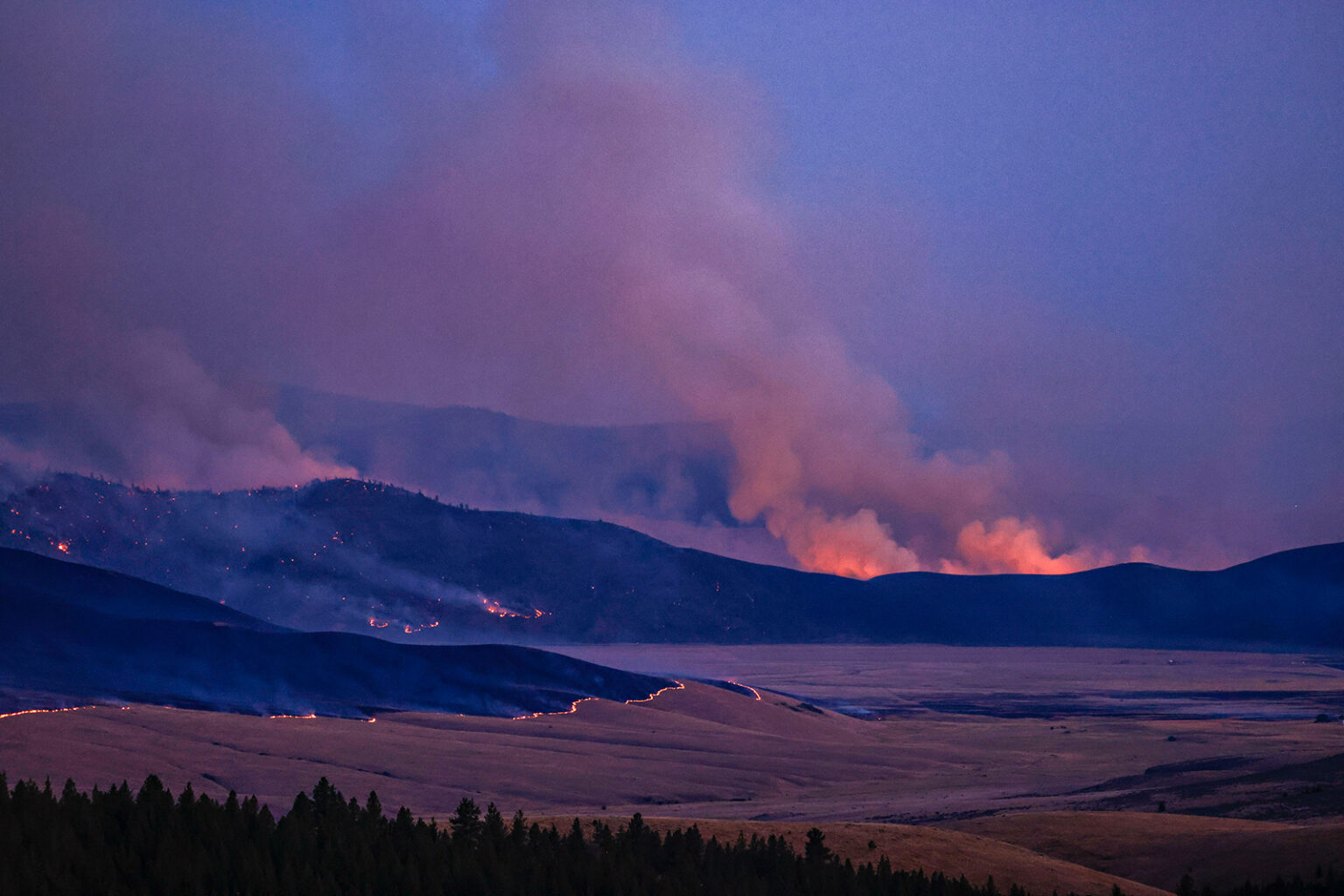
Fires and insect outbreaks are a reality in western forests. The workshop includes information about these disturbance events and making your forest more defensible and resilient to their impacts. One of our goals includes reducing our wildfire risk. One of the most effective ways to reduce your wildfire risk is to remove plants and flammable objects within five feet of your home. Building a new house allowed us to use fire-resistant materials, which increases the odds that our house will survive a wildfire. We’ve also done a lot of tree removal and canopy thinning around the house, so it will be great to talk with Jack, our resource specialist to hear additional advice for wildfire safety.
Photo from the Flathead Beacon:
Learn more about preparing your property for wildfire in the post below:
Firewise Home & Garden – Design, Garden, & Travel by Majestic Meadows
WILDLIFE HABITAT ENHANCEMENT
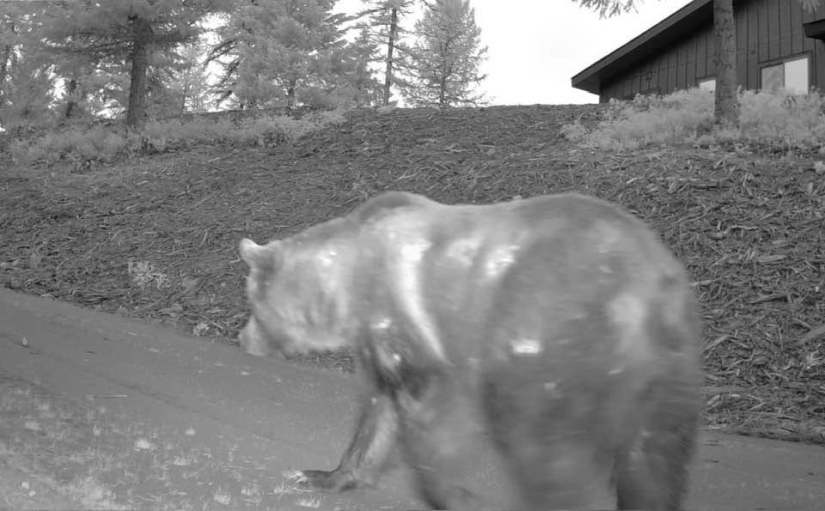
The wildlife on your property need food, water, cover, and space. The workshop shares ways to enhance habitat for various species. We’ve already made great progress adding food and cover by planting native trees, bunchgrasses, shrubs and wildflowers around our home. Our property supports many species, including predators such as brown (grizzly) and black bears, as well as mountain lions, coyotes, and fox. We also have white-tailed deer, rabbits, raccoons, skunks, birds, butterflies, and bees that depend on the resources on our property and surrounding areas. Pictured below is a brown bear captured on our trail camera in spring 2026:
TREES – the OVERSTORY
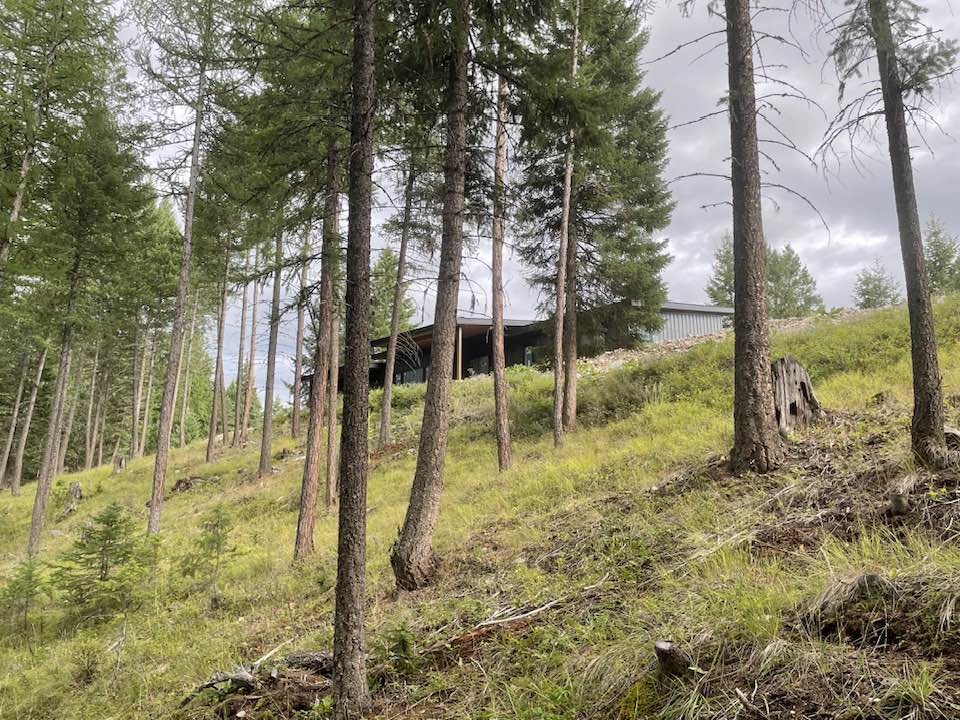
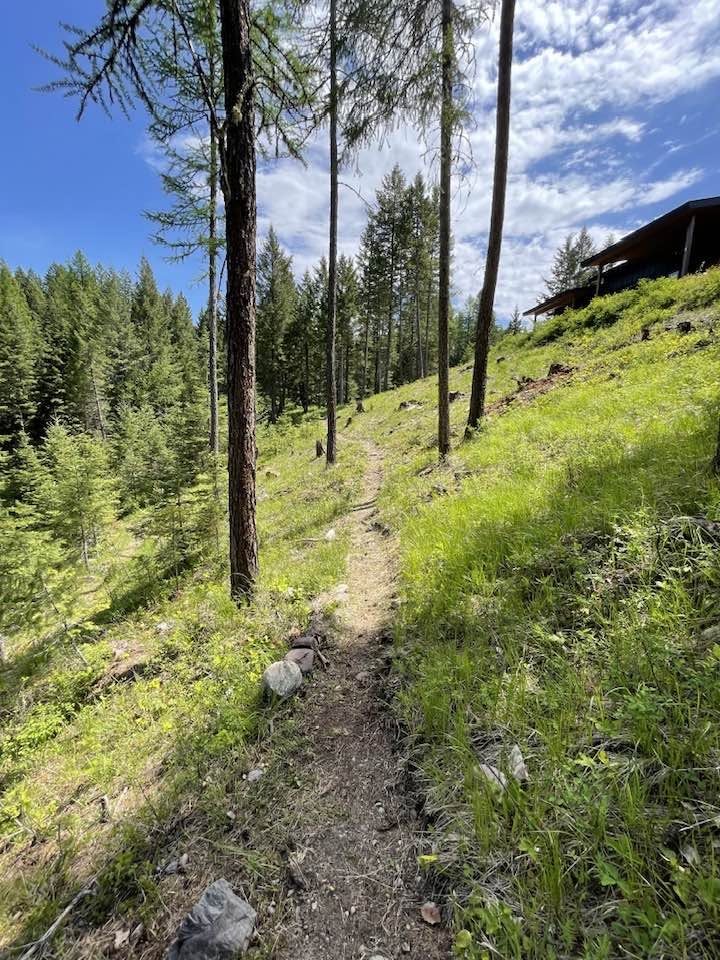
The workshop provides lot of tools to learn about the trees on your property, their condition and what they need to thrive and regenerate. Forest management guidelines have changed over the years, including some past practices resulting in an overgrown, crowded and potentially unhealthy forest. Thinning, limbing up and removing trees has been proven to increase the amount of water, sunlight and nutrients available to the trees left behind after this work. As you can see from the pictures below, we’ve removed most of the trees directly behind our house:
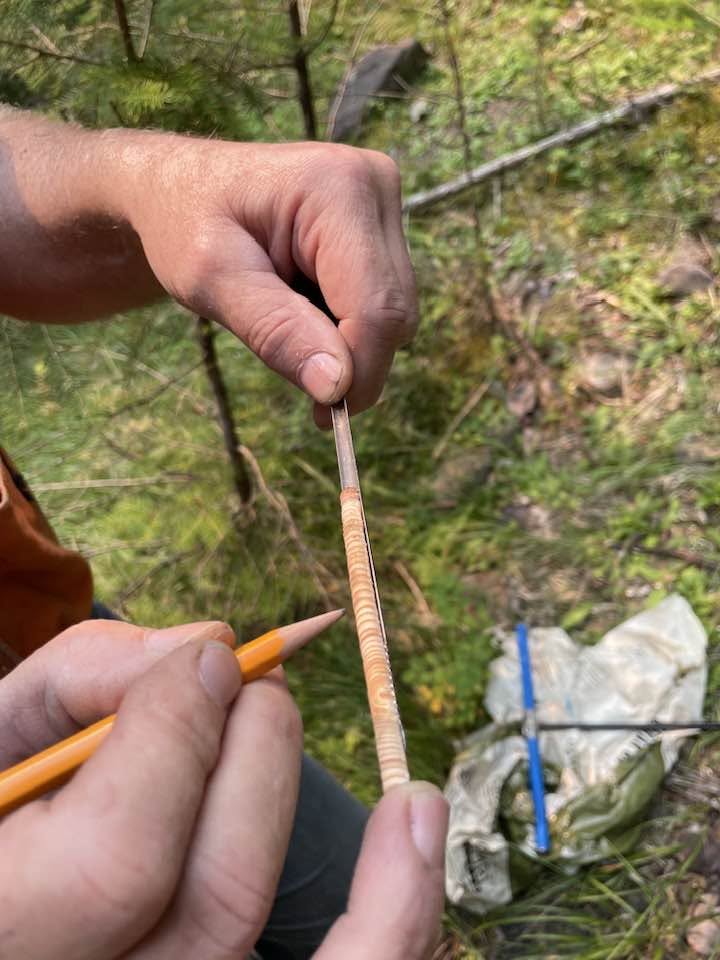
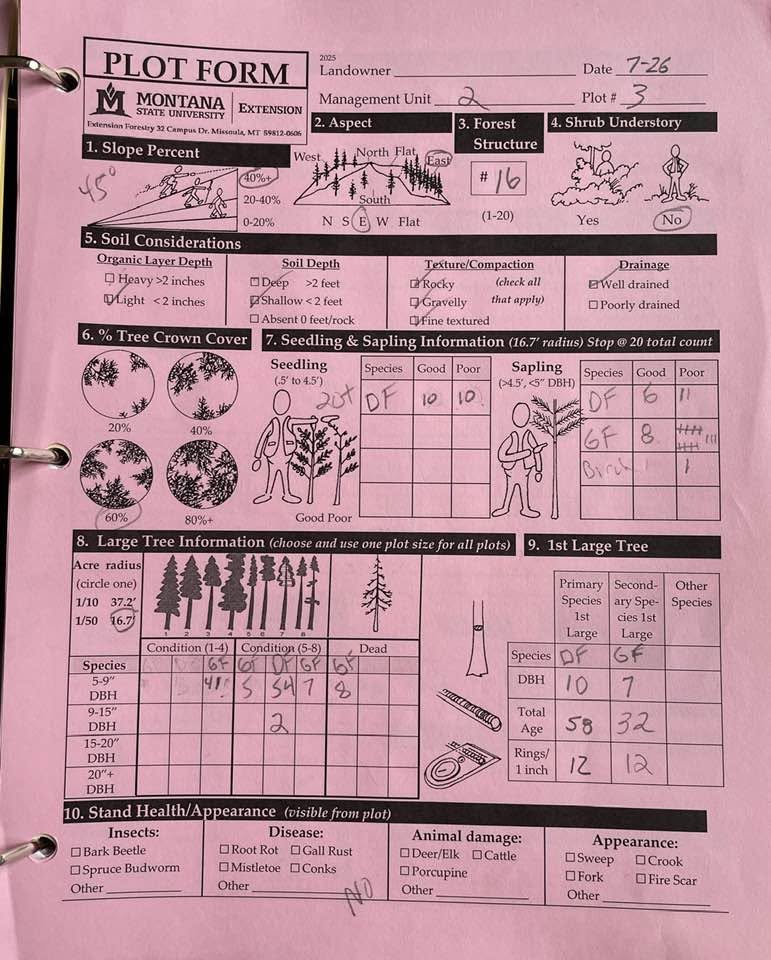
It was interesting to learn how to identify healthy trees, as well as determine their age and the overall forest structure on our property. One of our assignments was to complete plot surveys for the different management units on our property. As I mentioned previously, we have three units, which include the area around the house, 4-acres to our north and finally, 6-acres to the south. Each of the units have different trees and sizes, slopes, directional aspects, forest structures, ground coverage/shrubs, soil depths, and wildfire fuels. The plot surveys will help us create our management plan and determine priorities. Here’s a tree core, which we used to determine the age of a douglas fir and the front page of Plot #3 on Management Unit #2 for our property:
UNDERSTORY
Wildflowers, shrubs, seedlings, and weeds: forests have them all. Learn to identify plants, enhance some, and control others. We have no plans to harvest the trees in our forest, so balancing tree cover and understory plants is important to us. “Creating vegetation diversity is the best way to meet the multitude of habitat requirements for wildlife on your land.”
Native beebalm and western yarrow:
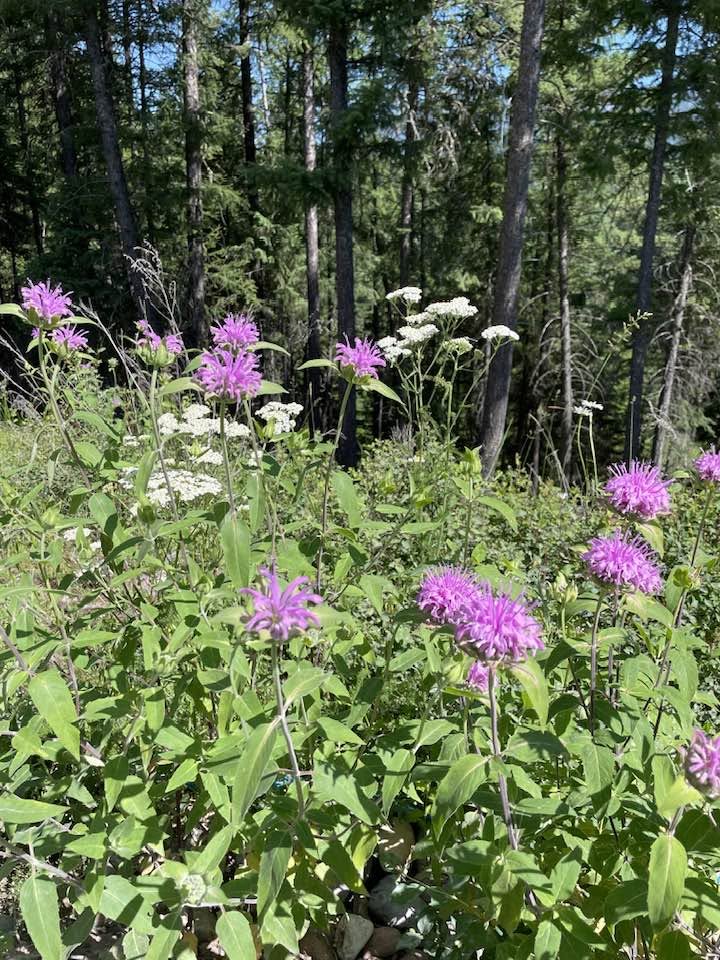
The workshop recommends a mosaic, or mix of open meadows, old timber, shrubs, and saplings. Our property already has natural “edges” or areas where open meadow meets a woodland. Deer can graze in the meadow then quickly disappear in the woodland area when spooked. Birds of prey watch on top of trees, then quickly swoop down to catch mice or other small mammals.
Pro-Tip: Brush piles are the most important factor for providing both cover and food sources for wildlife. Small mammals use brush piles for escape cover and a home. Be sure to build it so the base is off the ground to slow rotting and leave space inside for hiding and food storage. Brush piles should be away from your home and other structures.
FOREST HEALTH ASSESSMENT & MAINTENANCE
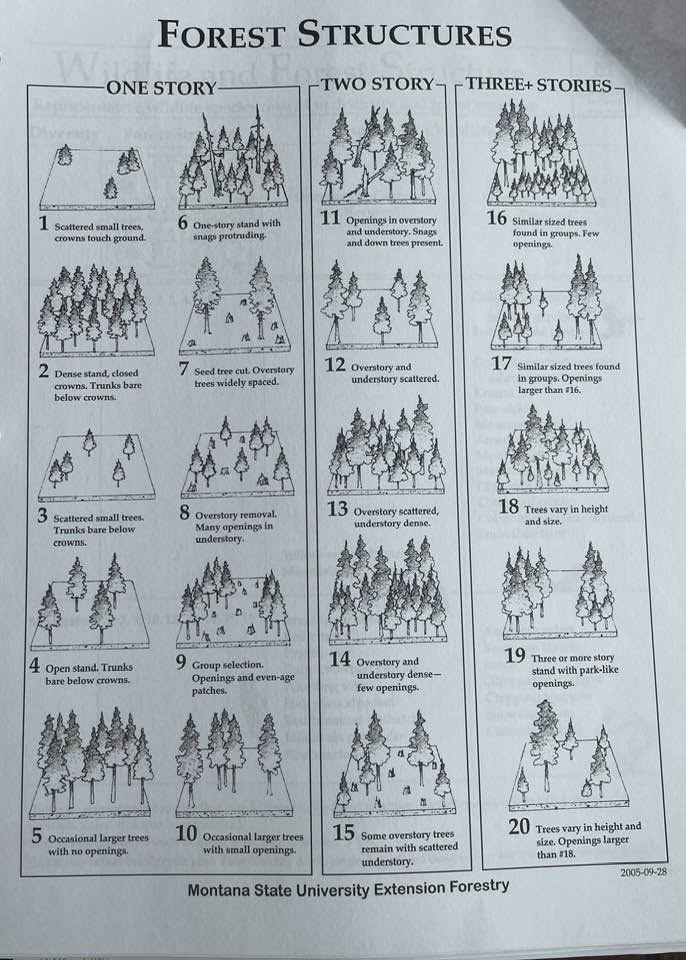
What is a healthy forest? The inventory we conducted took a critical look at the components of our forest. We assessed the age of trees, health risks, and the growth potential of our forest. All these data points provide options to improve its current condition. For example, we are lucky to have three-story forested areas with park like openings, which attract greater diversity of wildlife species than one story, or a single layer of forests:
Pro-Tip: Leave tree snags or dead trees for cavity nesting animals such as, sapsuckers, woodpeckers, bluebirds, owls, and fishers. Some species prefer dispersed snags and others prefer grouped snags. Consider the surrounding habitat when planning snags. For example, an isolated snag in a large meadow may become a bluebird home. Finally, snag height and diameter are important, so leave that large rotten tree as long as it will not fall on your home or other structures. Critters who use smaller diameter trees will use bigger trees, but critters of larger diameter trees will NOT use smaller trees. Bigger is better when it comes to snags.
Stewardship Plan Goals
Developing goals is the most important component in any Stewardship Plan. Constructing three or four main objectives you wish to accomplish on your property will force you to examine what is important to you. You will want to set specific goals. For example, here are our goals:
- Residence/Aesthetic: Keep Swan Range views open. In addition, we are seeding and planting native grasses, wildflowers, shrubs and trees in the areas destroyed by the construction of our new home. The perennial native garden (90%+) will screen neighbors, keep mountain views and maintain a park-like three-story forest.
- Fire: Maintain a defensible space around our home by removing and limbing up trees. This means we start with a noncombustible area within five feet of the house and 30 to 100-foot green space following recommended fire safety guidelines.
- Wildlife: Support and encourage existing wildlife with native plantings for habitat, food and shelter. Ensure attractants in our vegetable and fruit producing garden are protected with 6-foot electrified fencing. Finally, maintain a healthy three-story forest structure with western larch, douglas fir, spruce, rocky mountain maple, serviceberry and birch trees.
- Recreation: We’ve started our 1.25-mile hiking trail that circles the property, including carving out a trail down to the meadow and weed whacking to clear the trail. We’re also planning a cross-country ski trail for winter adventures. Finally, the edible and perennial gardens will provide beauty and outdoor activity most of the year.
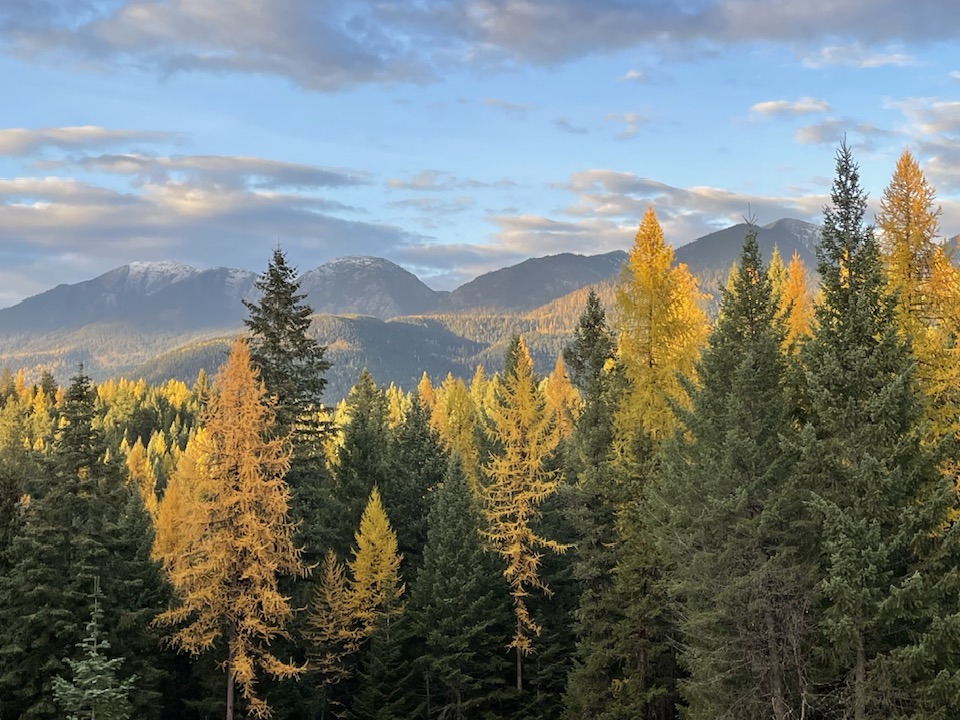
Our Western Larch trees really put on a show in the fall:
Workshop Details
The workshop cost was only $200, and all family members are welcome to attend. The classes are taught by a team of natural resource professionals, whose expertise and experience were well worth the cost.
Each workshop includes:
Home study: Videos and instructions to prepare for class can be completed on your own schedule.
Day 1: Check-in: 7:30 – 8:00 a.m. Indoor class 8 a.m. – 5 p.m.
Day 2: Outdoor 8 a.m. – noon & Indoor 1 p.m. – 5 p.m.
Between Days 2 and 3: Inventory your property – You will be supplied with equipment necessary to perform a stewardship inventory on your property. This can be accomplished in the evenings after work for smaller properties (<20 ac.), or may take a couple days for larger properties.
Day 3 Indoor class: 8 a.m. – 5 p.m.
On-site Consultation Following the Workshop
After completing the plan, a Certified Stewardship Advisor will visit you, at no additional cost for about 2-6 hours. This is a great opportunity to consult with a resource professional about your objectives, your forest, and your Forest Stewardship Plan.
“Montana forests are valued for wildlife, fisheries, livestock grazing, watershed protection, recreation, and wood products. Nearly two-thirds of Montana’s 23 million acres of forest land is publicly owned, mostly by Federal Government agencies. The next largest ownership is Non-Industrial Private Forest (NIPF) landowners. These 50,000+ individuals control over twice the acreage of the forest products industry. NIPF owners and their 3.8 million acres are the focus of the Forest Stewardship Program. Montana State University Extension Forestry operates from the premise that there is a lot landowners can do for themselves if given the know-how. We believe in empowerment through personal involvement. Our goal is to help develop a lifelong relationship between a landowner and their property. We concentrate on developing critical thinking skills, problem-solving and decision-making skills. We teach people to observe, measure, gather and classify data. This results in the ability to discuss, interpret, and predict. Participants can then assess the trade-offs and consequences of their management activities and make informed decisions.”
Visit the website to enroll and learn more:
Forest Stewardship Program – Forest Stewardship Program | Montana State University
Garden Update
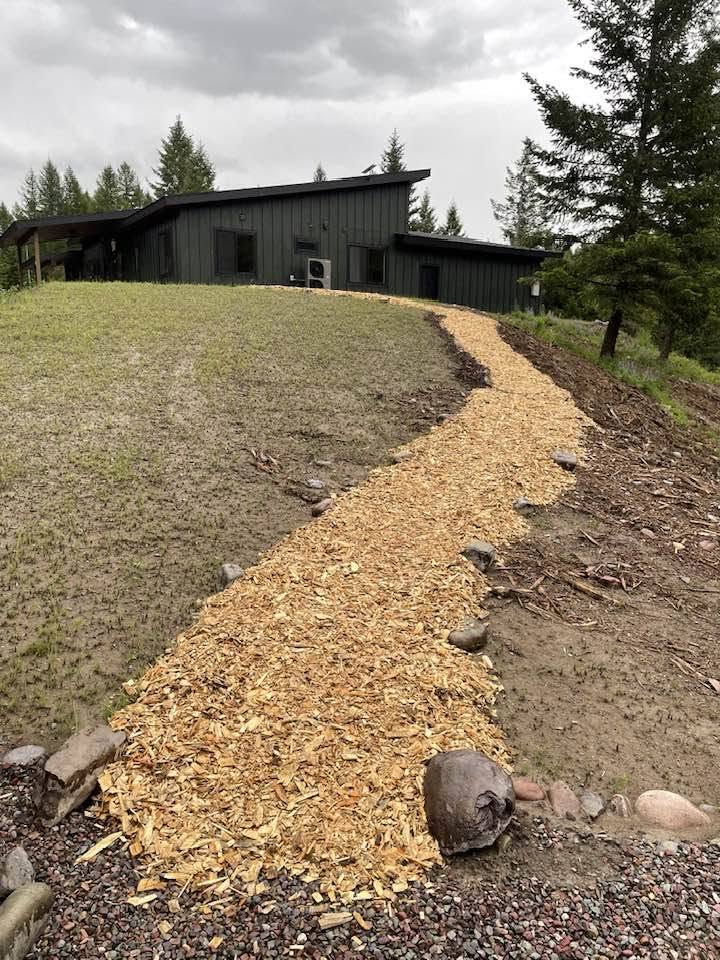
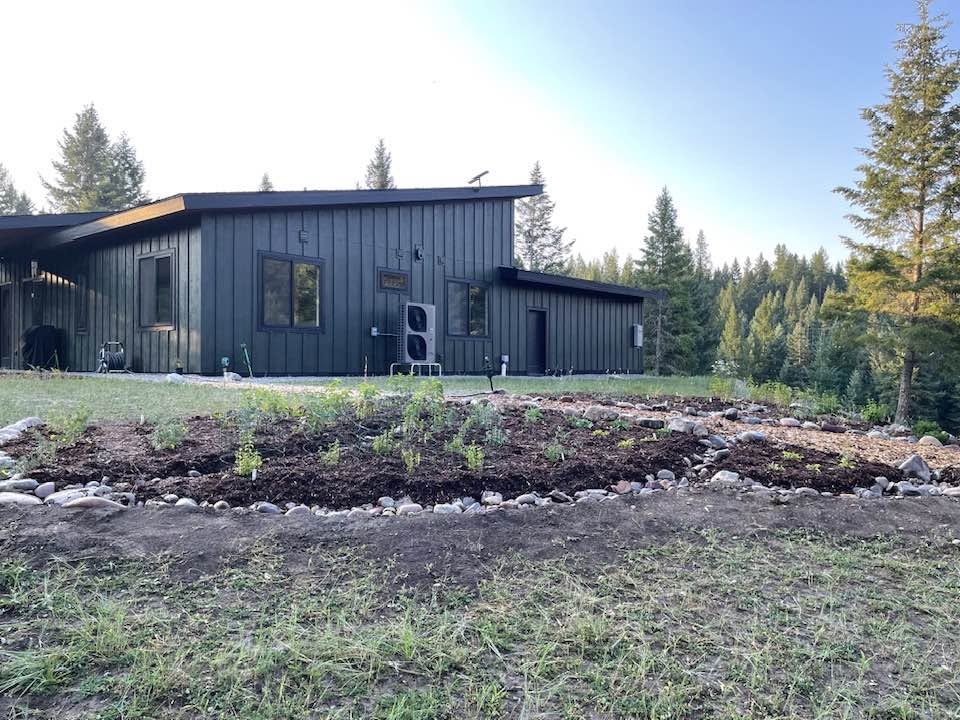
The new house build meant garden areas around the house had to be seeded or planted. We started by spreading native bunchgrass and wildflower seeds when the snow started last winter so they could get the cold stratification needed to sprout. This spring the grasses and wildflowers started to grow and bloom. Since my last post, we’ve added a large garden bed on the west side of our house and a mulch path down to the firepit and edible garden. The path makes it a quick trip to harvest, water or check on the edible garden and eventually, we’ll replace the mulch with gravel. Here is the area before the garden bed was completed:
Below you see the new garden beds and edible garden from the house:
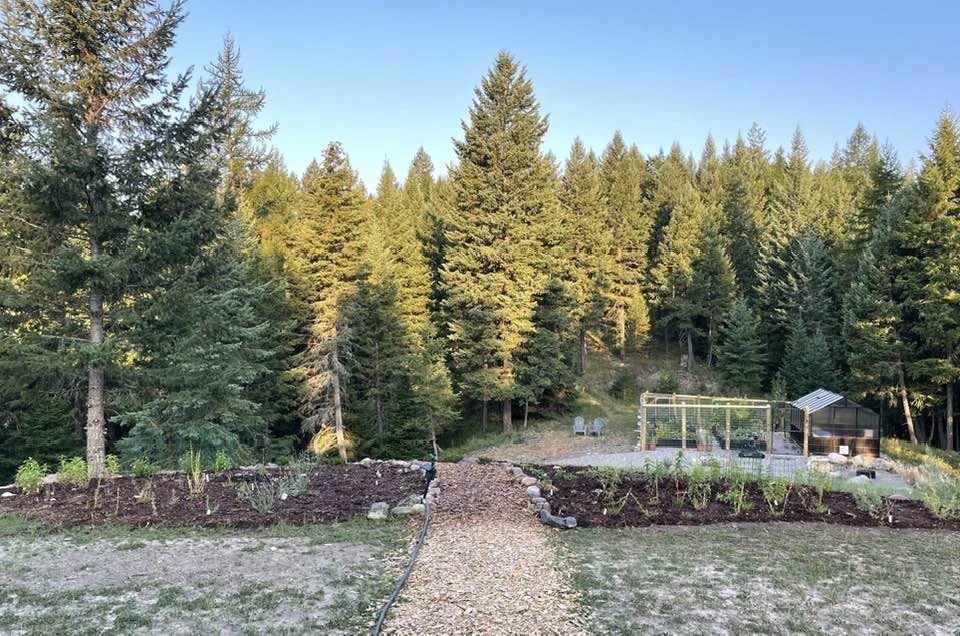
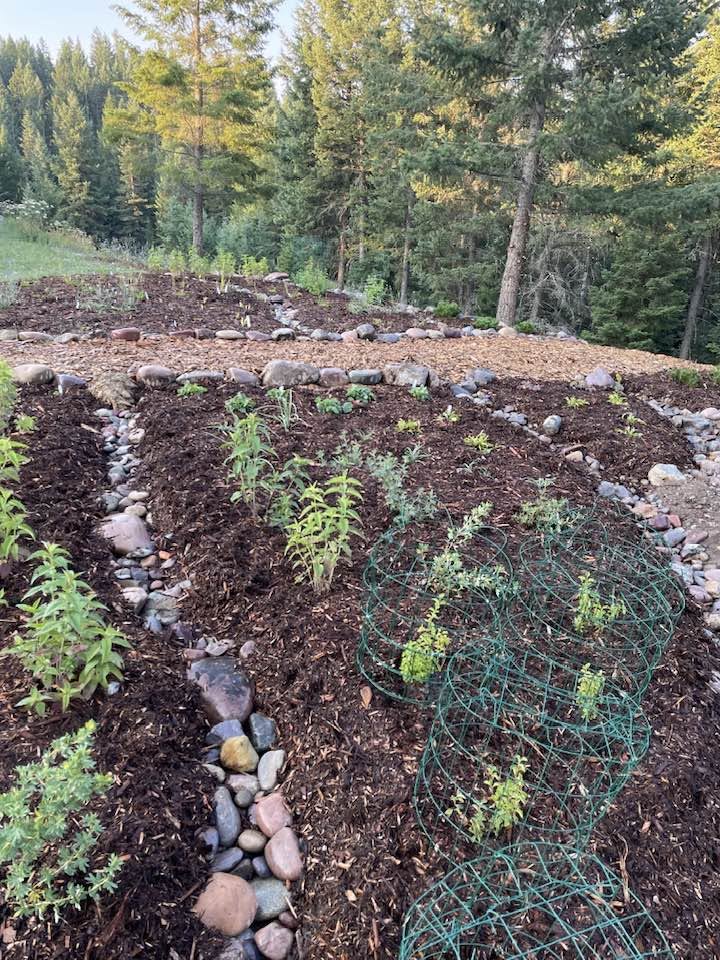
We chose to install 90% native perennial plants in the garden because they are drought tolerant and support wildlife such as pollinators and birds. These plants will return year after year. Because we are planting on a slope, we dug out shallow swales and filled them with rocks. Most of these rocks came from the plant holes we dug. These swales will collect water to help keep the soil moist and stop erosion on the hillside.
Learn how we are Meadowscaping around our home with native plants below:
Meadowscaping with Natives – Design, Garden, & Travel by Majestic Meadows
Once again, we visited The Center for Native Plants to purchase native perennials for this garden project. This local nursery has a full inventory of native plants, including trees, shrubs, grasses, wildflowers and seed. We enjoy listening and watching birds, which eat a variety of different things depending on the species and time of year. Food may include berries, buds, grubs, insects, moths/butterflies, caterpillars, and for large birds of prey, small mammals. The plants we’ve introduced will provide shelter, nesting and food for birds into the winter season.
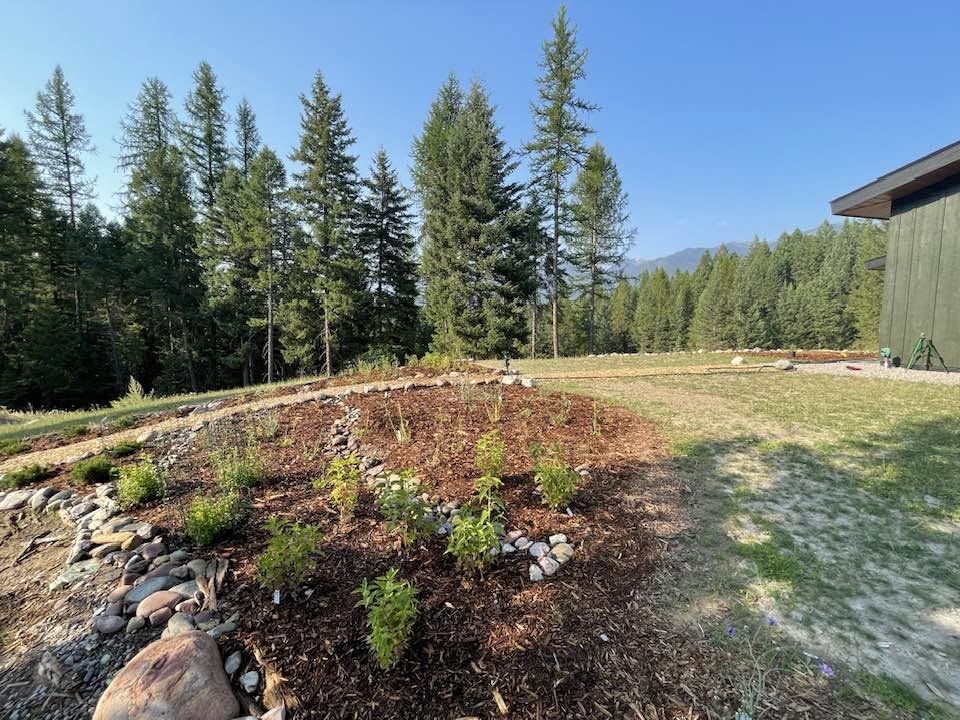
This large garden bed includes the following natives:
- Mock Orange/Philadelphus lewisii
- Cinquefoil/Dasiphora fruticosa
- Beebalm/Monarda fistulos
- Harebell/Campanula rotundifolia
- Western Spiderwort/Tradenscantia occidentalls
- Oregon Grape/Berberia repens
- Rocky Mountain Penstemon/Penstemon strictus
- Violet/Viola adunca
- Rocky Mountain Goldenrod/Solidago multiradiata
- Arrowleaf Balsamroot/Balsamorhiza sagittata
- Wilcox Penstemon/Penstemon wilcoxii
- Alumroot/Heuchera cylindrica
- Dwarf Mugo Pine (nonnative)
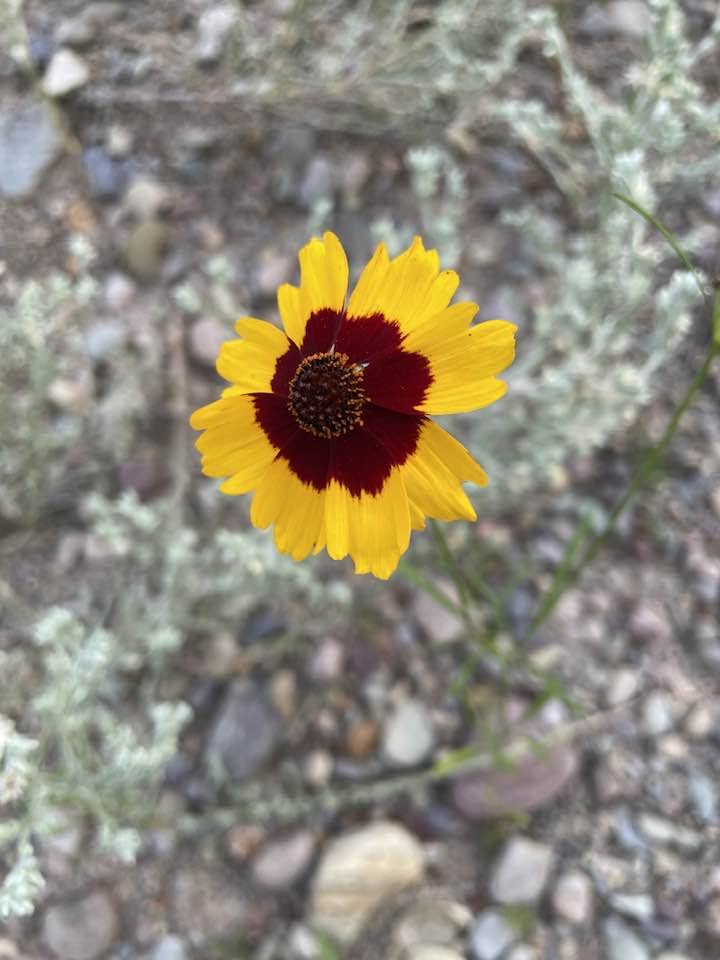
Below you see a plains coreopsis, which was started from seed last fall. This beautiful annual native wildflower is drought tolerant and grows up to 3 feet tall in full sun and well-draining soil. If cut back by one-half it will bloom a second time, instead we will leave the seed heads for critters and new plants next year.
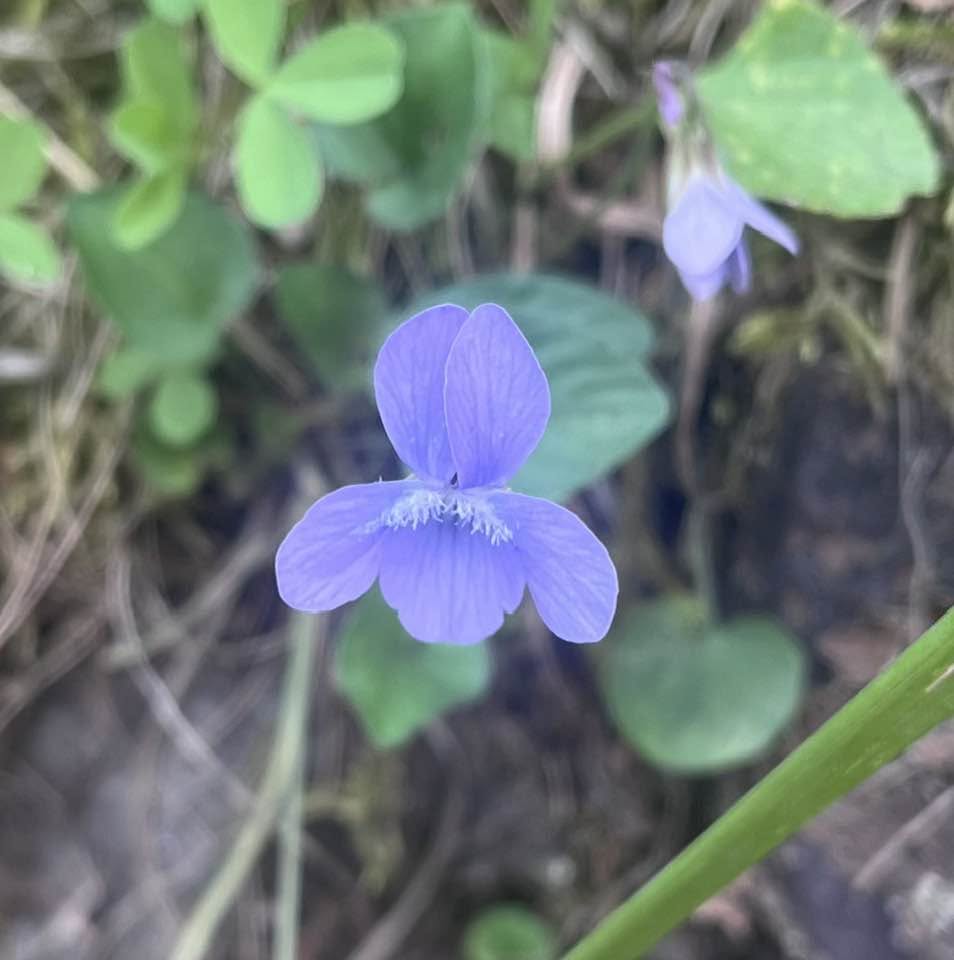
We have several wild native Violets growing along our trail down to our north meadow overlooking the Swan Mountains:
There are invasive weeds in areas disturbed during the property development in the 1980s, we are removing these using a variety of methods, including pulling, burning, removing flowers and spraying herbicides. The garden along our driveway has both invasive weeds and beautiful natives, such as beebalm (purplish flowers), spreading dogbane, lupine and grasses:
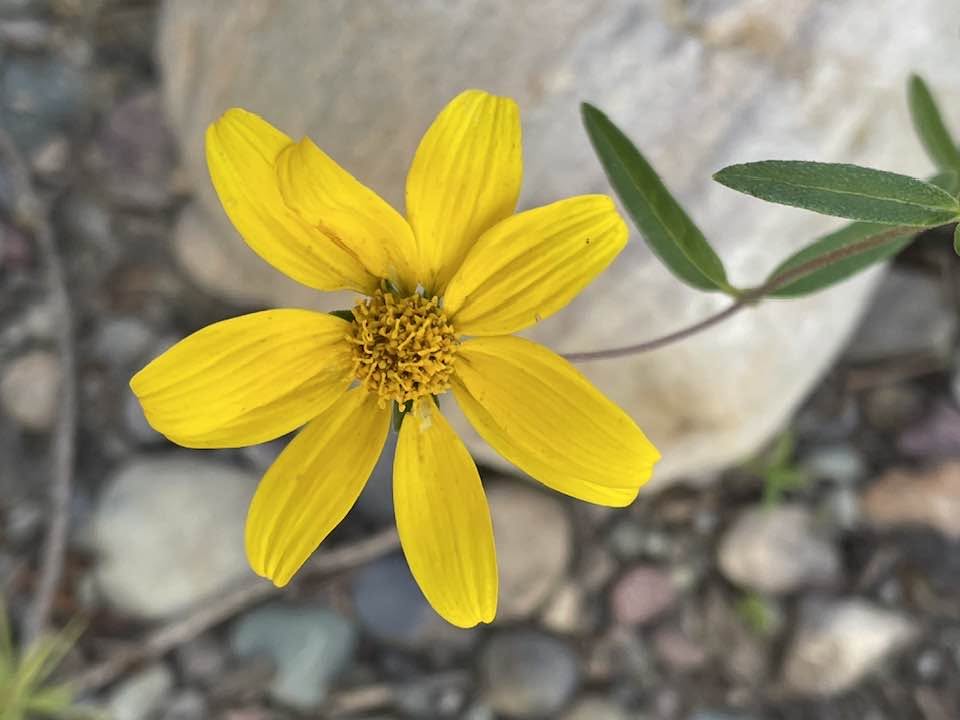
We planted this showy goldeneye with its beautiful, sunny flowers as a plug last fall:
I can’t believe we’ve been in the house for almost a year now. We absolutely love the house and feel incredibly grateful to our builder, J Martin Builders and all the contractors that worked on the house. My hubby, Jimmy and I love spending time outdoors and we are really happy with the progress we’ve made in the garden. I’ll be sharing more of our NW Montana adventures, as well as garden and house updates, so subscribe below to follow along.
If you’d like to see for yourself how far we’ve come, or would like more gardening, interior design or adventure tips be sure to check out some of my prior posts at:
Design and Travel Posts – Design, Garden, & Travel by Majestic Meadows
We’re heading over to Babb, MT next weekend to explore a more remote section of Glacier National Park. Stay tuned for an update on our latest adventure!


Leave a comment